
Every year thousands of people search for a way to finish a bachelor’s degree, add an online MBA, or move into a doctorate without quitting a job or moving countries. Unicaf comes up constantly in that search. It also comes up wrapped in a lot of noise, and a fair amount of it is wrong.
This guide sticks to what is actually documented on Unicaf’s own website and on the websites of the universities it works with. No hype, no “fully funded” promises that fall apart at the payment stage. If you are weighing this against a local university, a distance learning programme, or a student loan, you should be able to finish reading and know whether it is worth your application.
What Unicaf actually is
Unicaf is an online education platform. It does not award degrees under its own name in the UK. Instead, it partners with universities, delivers their programmes through its own online learning environment, and offers scholarships that reduce the tuition fee those universities charge.
Two things follow from that structure. First, the certificate you graduate with carries the partner university’s name, not Unicaf’s. Second, the scholarship is essentially a tuition discount funded by the arrangement between Unicaf and the university, which is why the size of the award varies from applicant to applicant.
Unicaf also operates its own institutions, Unicaf University in Malawi and Unicaf University in Zambia, which award degrees directly.
The honest answer on funding: up to 75%, not 100%
This is where most articles about Unicaf mislead people, so it is worth being blunt.
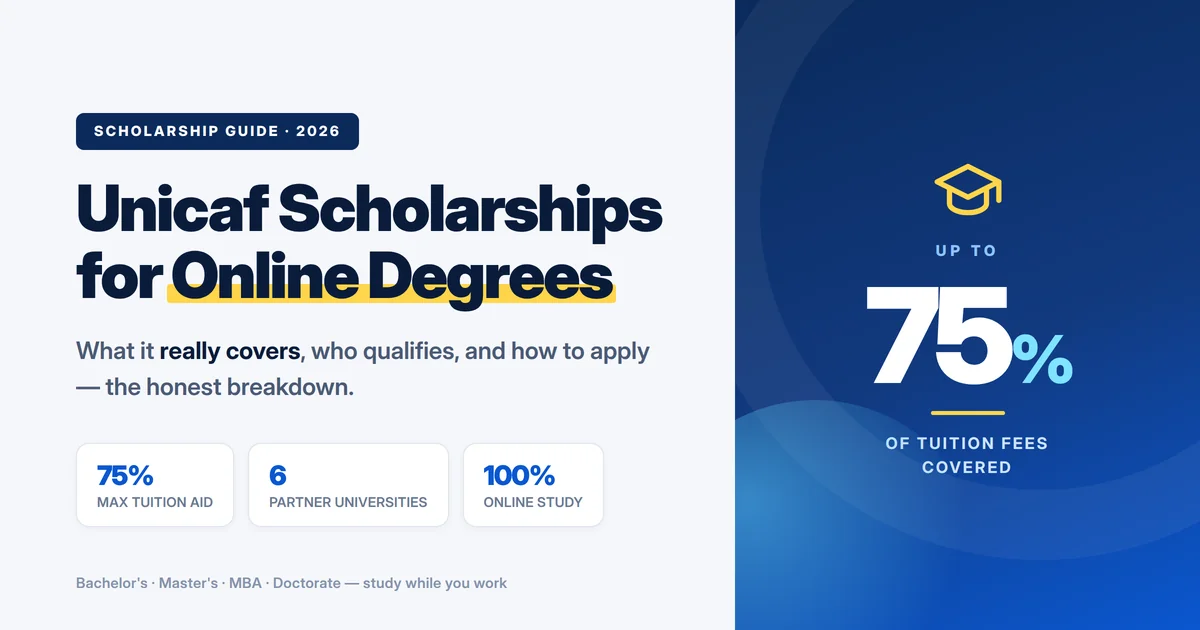
Unicaf’s own materials describe scholarships covering up to 75% of tuition fees for eligible students. “Up to” is doing real work in that sentence. Some applicants are offered less. Nobody is offered a free degree.
Unicaf itself calls these part-scholarships, and it says openly that the remaining balance is paid by the student, usually through a monthly instalment plan arranged around the applicant’s circumstances. So the practical question is never “is it free” — it is “what is the remaining balance, in my currency, and can I service it for the next two or three years?”
You will not know that number until you apply. The scholarship committee reviews each application and sends the exact fee for your chosen programme afterwards. Anyone quoting you a precise figure before that point is guessing.
The universities you can study with
Unicaf currently lists the following partners:
- University of East London (UK)
- Liverpool John Moores University (UK)
- University of Suffolk (UK)
- University of California, Riverside — professional courses through UCR Extension (US)
- Unicaf University, Malawi
- Unicaf University, Zambia
The three UK universities are established public institutions with their own campuses and their own quality assurance obligations. That matters more than any marketing line: when you check whether a qualification will be recognised by an employer or a professional body, you check the awarding university, not the platform that delivered the teaching.
Liverpool John Moores and the University of Suffolk both maintain their own public pages describing the Unicaf partnership, which is a useful sanity check for anyone worried about legitimacy.
Degree programmes on offer
The catalogue is broad, and it leans heavily toward business, health, education, and technology — the fields where an online qualification tends to translate most directly into a promotion or a career switch.
Bachelor’s level: business administration, accounting, finance, computer science, nursing, law, and hospitality management.
Master’s level: the MBA is the flagship, with specialisations including finance, marketing, and health management. Alongside it sit a range of MSc programmes, an LLM in law, a Master of Education, a Master of Public Administration, and a Master of Public Health.
Doctoral level: DBA, EdD, and PhD routes across business, education, law, technology, and public health.
If you are specifically after an online MBA scholarship, this is the part of the portfolio Unicaf pushes hardest, and it is where the largest number of specialisation options sits.
Who is eligible
Unicaf assesses applicants on three stated criteria: academic qualifications, financial ability, and country of residence.
That third criterion surprises people. It is not a mistake. The award size is calibrated partly to where you live and what tuition is realistically affordable there, which is why two applicants with identical transcripts can receive different offers.
On academic background, the application form accepts a range of entry levels:
- GCE A-levels or a high school diploma
- BTEC HND or a foundation degree
- A completed bachelor’s degree
- A postgraduate qualification or master’s degree, for doctoral applicants
Entry requirements tighten as you move up. A doctorate will expect a relevant master’s; an MBA will expect a bachelor’s and, in most cases, some professional experience. Because teaching and assessment are in English, applicants from non-English-speaking backgrounds should expect to evidence their English proficiency in some form — check the exact requirement with an admissions adviser for your specific programme, since it differs by university.
What the application process looks like
The process is short, which is deliberate — Unicaf recruits continuously rather than to a single annual deadline.
- Submit the online application. Personal details, contact information, your current level of education, and your chosen programme.
- Speak to an adviser. Unicaf assigns student advisers who follow up by phone or email. Treat this as a two-way interview and come with questions.
- Provide documents. Transcripts, certificates, identification, and any English language evidence required.
- Receive the scholarship decision. The committee confirms the award and the exact tuition balance remaining.
- Agree a payment plan and enrol. Intakes run several times a year rather than once, so start dates are flexible.
There is no single application deadline to race. That cuts both ways: it removes pressure, but it also means nothing stops an adviser from encouraging a quick decision. Take the time you need.
The real cost, and how to budget for it
Tuition is only part of the picture, and building a realistic budget before you enrol is the single most useful thing you can do.
Work out the remaining balance after the scholarship, divide it by the number of months in the programme, and compare that monthly figure against your income today — not the income you hope to have after graduating. Then add the things that sit outside tuition: a reliable internet connection, a device that can handle the learning platform, exam or resit charges if any apply, and graduation costs.
One genuine saving is worth acknowledging. Studying online removes relocation, visa, and living costs abroad, which for an international student is frequently larger than the tuition itself. A UK degree earned from your own city is a fundamentally different financial proposition from a UK degree earned in the UK.
Where an online degree fits — and where it does not
Online study suits people who already have work discipline and a reason to study. It suits someone who needs a formal credential to unlock a band or a licence, someone changing sector, and someone whose employer part-funds study.
It suits far less well anyone hoping for a campus experience, an in-person professional network, or a route to migration. Studying online from home does not produce a student visa, and it should not be sold to you as a pathway to one.
Be equally clear about the workload. A part-time master’s alongside full-time employment is a real commitment — assume ten to fifteen hours a week for two years and plan accordingly. Most people who drop out do so because of time, not money.
Questions worth asking before you commit
Before you sign anything, get written answers to these:
- Which institution awards the degree, and what exactly will the certificate say?
- What is the total tuition fee, and what is my balance after the scholarship?
- What is the monthly instalment, over how many months, in which currency?
- What happens if I need to pause my studies or withdraw? What is the refund policy?
- Is this qualification recognised by the professional body or regulator in my country?
That last one is critical and frequently skipped. Recognition rules for nursing, law, teaching, and accountancy are set nationally by regulators, and no university or platform can guarantee an outcome on their behalf. Verify it with the regulator yourself, in writing, before you enrol.
Frequently asked questions
Is the Unicaf scholarship fully funded?
No. Unicaf describes awards covering up to 75% of tuition. The remaining balance is paid by the student, typically in instalments.
Will my certificate say Unicaf?
Only if you study with Unicaf University in Malawi or Zambia. If you study through a UK partner, the degree is awarded and certified by that university.
Is there an application deadline?
Unicaf operates rolling admissions with multiple intakes per year rather than one fixed deadline.
Can I work while studying?
Yes — the programmes are built for part-time online study, which is the main reason working professionals choose them.
Do I need IELTS?
It depends on the university and your background. Ask an admissions adviser about your specific programme rather than relying on general advice.
Is Unicaf legitimate?
Unicaf is a real company with publicly documented partnerships; the UK universities involved describe those partnerships on their own websites. Legitimacy and value are separate questions, though — a genuine degree can still be the wrong purchase if the balance is unaffordable or the credential is not recognised where you need it.
The bottom line
A Unicaf scholarship is a substantial tuition discount on an accredited online degree, not a free ride. For a working professional who needs a recognised qualification and cannot relocate, that discount can be the difference between studying and not studying. For someone expecting a fully funded degree, it will be a disappointment.
Apply if the numbers work after you have seen them in writing. Walk away if they do not. And do the recognition check with your own regulator before anything else.
Disclaimer
This article is provided for general information only and is not financial, immigration, or educational advice. Scholarship terms, tuition fees, partner universities, and entry requirements change over time. Verify all details directly with Unicaf and the awarding university before making any financial commitment. This article is independently written and is not affiliated with, endorsed by, or sponsored by Unicaf or any university named in it.